Fear & Guilt
Fear and guilt are terms that critics have linked together as they agree that guilt makes the fear more palpable. In terms of this argument, the critics are saying that guilt makes fear more noticeable. In this sense, critics have been linking fear to Macbeth as a reason for this infection that provides weakness to the body such as guilt. Fear has also been linked with guilt as the characters are motivated by fear of doing their wrongful acts. Critics are arguing that characters in Macbeth often feel fear of the lack of cures for diseases throughout the play Now what I do agree with is that many of the characters did get infected after taking part in their monstrous act Macbeth went mad and at the terms of power was going to kill anyone who got in his power of being king with no remorse, and Lady Macbeth became infected with PTSD after helping Macbeth completing the act of killing Duncan as she showed signs of sleepwalking and scrubbing the imaginary blood off her hands as a result of the killings her and Macbeth committed. (Hobgood)
While critics have stated Macbeth’s fear is because of sickness, something that I have noticed when I used textual analysis is how Macbeth’s fear of Macduff is connected to power and guilt. Using textual analysis, I was able to find out that fear and Macduff were correlated through collocates and then uncover the ways in which fear and Macduff was being used and what patterns I found. Although critics have suggested that Macbeth has done things out of fear as a result of illness throughout the play, with distant reading I have noticed that Macbeth’s fear and Macduff tie closely together. According to Voyant, fear and Macduff are mentioned throughout the play, and in some places, there are higher peaks than others. The part of Macbeth that I chose to analyze is from Act 4 Scene 1, and throughout the play, this scene is where Macduff and fear were most intertwined. Breaking up this scene helped me find patterns and connections that I wouldn’t have seen before when I was reading Macbeth as a full text.
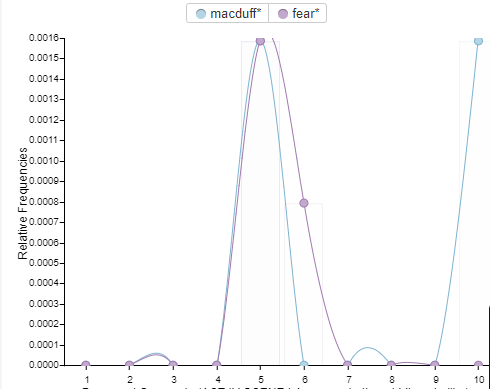
In this graph, the blue line represents Macduff and how often he is talked about and mentioned in this scene. And the purple line represents fear and using this tool is helpful to know when a particular subject is being talked about less or when it is being talked about at the highest peak.
How Fear & Macduff are getting spoken about in the text & what makes it significant
Whate’er thou art, for thy good caution, thanks;
Thou hast harp’d my fear aright: but one
word more,– (Shakespeare, 4.1. 84-87)
In this context, fear appears as a statement to Macbeth telling him a thought that he feared would happen. Fear in this sense is not Macbeth outright saying that he knew Macduff was a fear, but instead is stating that this is something that he had feared from him. But a pattern that is being expressed is that Macbeth is calm despite being given a reason not to be, by the witches. “Thou hast harp’d my fear aright”(Shakespeare, 4.1.84). Macbeth is feeling passive as he dismisses the advice that the witches told him. To break it down even further Macbeth is passive about what he is told at first, then begins to take action on it later. Through this scene, there is a pattern of Macbeth being calm in a situation in which the witches warn him to be afraid. While doing a close reading of the language, something to take notice of is how Macbeth is reacting to fear in a passive way. While the witches are abrupt with this news stating “Macbeth! Macbeth! Macbeth!” on the other hand Macbeth is showing a pattern of not being as phased as he should be. For instance, you can notice Macbeth reacting passively to fear in this line.
“Thou hast harp’d my fear aright: but one
word more”
Macbeth states that was a fear that he had but then proceeded to show no initial emotion about it and in a way tries to dismiss it. The way that Macbeth reacts to fear in a passive way can tell us that he isn’t afraid of Macduff but with this language, you can tell that Macbeth will have no reaction or feel no guilt to murdering Macduff’s family. Macbeth proceeds to react to fear passively throughout the entire scene and we need to think about what does that tell us about himself as well as what does it tell us about how he thinks about Macduff. Moving forward, this pattern of Macbeth reacting to fear in a nonchalant way can show us how the process came undone when Macbeth decided to kill Macduff’s family. If Macbeth is handling this notion of fear in a passive way, then there is also a pattern of him being passive when he orders to have Macduff’s family killed. This continuous pattern can tell us Macbeth has gone insane and there isn’t any guilt to murder anymore, just wanting to gain more power.
“That I may tell pale-hearted fear it lies,
And sleep in spite of thunder.” (4.1.83-86)
In this line, fear is being used as Macbeth’s own fear stating that even if what the witches said were true, he wants to kill Macduff so he can sleep easy at night knowing the weight of the murders are weighing on his back and live without fear. Macbeth thinks that killing Macduff he won’t have to live in fear anymore. A pattern that I noticed with this line above as well as this line
Whate’er thou art, for thy good caution, thanks;
Thou hast harp’d my fear aright: but one
word more,
is that both of these lines contain Macbeth’s suspicion but they are presented in different ways. In the first line, Macbeth is feeling suspicion from Macduff which allows him to feel fear from him, while in this line Macbeth is feeling it through his own suspicion and his own paranoia which is a part of the reason why he still lives in fear while sleeping.
“That I may tell pale-hearted fear it lies, And sleep in spite of thunder.” In this sentence, fear is also used as personification as Macbeth is referring to his heart as an emotion; fear. Fear in this context is being used as Macbeth’s own feeling, his own paranoia mentioning that he doesn’t fear Macduff even though he is seen as a threat.
“Then live, Macduff: what need I fear of thee? But yet I’ll make assurance double sure And take a bond of fate. Thou shalt not live:” (4.1.93-95)
In this line, Macduff is being talked about directly by Macbeth and although he is starting to see that Macduff has become a threat, news received by the witches he still feels he has no reason to be afraid of Macduff. Macbeth is simply stating “Why should I be fearful of you if you were born from a woman”. Fear in this context is a statement as well as being represented to question his self-conscious thoughts. Then Macbeth proceeds to want to kill Macduff anyways to protect himself and to get rid of the fear he still has when he is asleep.
The Patterns I have noticed throughout the scene in terms of how fear and Macduff are being spoken about
From the scene, I am noticing a different pattern that is interesting, in one line he is talking about why would he need to be fearing this specific person, and in the next two lines he is stating he is feeling fear because of the murders he has committed and he has sparked a new fear because of the suspicion he had suspected from Macduff. And in another line, he is stating that he had feared something like this from Macduff. It is interesting how fear is falling into slightly different patterns while how Macduff is getting talked about falls into the same pattern. Each time that Macduff is brought up is for the same reason; telling Macbeth to be afraid of Macduff and Macbeth talking about Macduff.
What I did notice is that with this connection Macduff isn’t actually talking in this scene to make it connected, it is the way that Macduff is being talked about that creates a connection with fear. The patterns that I am noticing is that looking at the two mentions that are correlated with Macduff it is really cool to see the contrast where in the first mention, the witches are telling Macbeth to beware Macduff but in the second mention it is Macbeth stating that he thinks Macduff should live there is no reason as to why he should fear him but then again states that he will kill him anyways in case fate is right.